














News
Can Liners for Offices and Commercial Spaces: Sizes and Strength
Nov
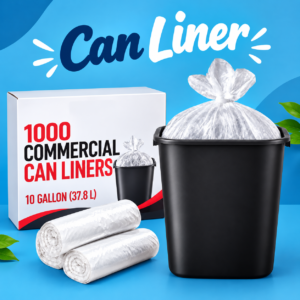
Running an office means someone has to think about the trash, and that job gets much easier when you buy can liners bulk instead of grabbing a small box at a time. The right liner fits the can, holds a full day of waste without tearing, and comes out cleanly when the cleaning crew makes its rounds. The wrong one splits at the worst possible moment. This guide covers the sizes and strengths that matter in commercial spaces, so every bin in your building, from desk-side cans to the kitchen, is properly covered.
If you are setting up your workplace supplies from scratch, our complete guide to bulk disposable essentials walks through every category a business needs, not just the bins.
Start with the Can, Not the Liner
Liner sizes are meaningless until you know your cans. Check the gallon capacity stamped on the bottom of each bin, or measure the height and the width across the top. A liner should be a few inches taller than the can so it folds over the rim, and wide enough that half its width matches the can’s top measurement with a little to spare.
Most offices use the same handful of can sizes. Desk-side and restroom bins are usually 3 to 13 gallons. Slim hallway and break room cans are often around 23 gallons. Kitchen, cafeteria and copy room cans run 33 gallons and up. Once you know your two or three sizes, you can match them against the can liners in our range and standardize, which makes ordering and restocking far simpler for whoever handles supplies.
Low-Density vs High-Density: Picking the Right Strength
Commercial liners come in two main film types, and they behave very differently.
Low-density liners are thicker, stretchy and forgiving. They resist punctures from food scraps, box corners and broken items, and they flex instead of splitting when a bag is overfilled. They are the safer choice for kitchens, cafeterias and mixed waste.
High-density liners are thinner, stiffer and noticeably crinkly. They cost less per liner and handle smooth, light loads well — office paper, tissues, packaging film. Their weakness is sharp edges, which can poke through and start a tear.
A useful rule: if the waste is light and dry, high-density is fine. If it is wet, heavy or sharp, choose low-density. The same logic applies at home, which is why our guide to choosing kitchen trash bags without leaks or tears is worth a read if you manage both spaces.
A Simple System for the Whole Building
You do not need a different liner for every room. Three tiers cover almost any workplace:
Desk-side and personal office bins
Use small high-density liners. The waste is paper and light packaging, the bags are changed often, and cost per liner matters more than brute strength.
Break rooms and kitchens
Use low-density liners in a mid-to-heavy weight. Coffee grounds, food waste and liquid make these the hardest-working bags in the building. General-purpose trash bags in the right gallon size work well here too.
Restrooms and janitor closets
Small liners fit sanitary and restroom cans, and this is also where your backup stock should live. When the cleaning team can grab a fresh roll without hunting through cupboards, bins never sit unlined.
How Bulk Buying Keeps the Whole System Cheap
Standardizing on two or three liner sizes lets you buy full cases, which is where the real savings are: the cost per liner drops, the cleaning team always finds the right roll, and nobody makes an emergency retail run at the worst moment. Can liners are just one line on the full checklist of disposable essentials every small business should keep in stock, and ordering them together is easier still. At Techlenze, orders ship anywhere in the USA with same-day or next-day delivery, shipping is free on orders of $75 or more, and a flat $2.99 applies under $75 — so a restock never has to wait a week.
Frequently Asked Questions
What size liner fits a 23-gallon slim office can?
Look for a liner rated for 23-gallon slim or “slim jim” style cans, with enough extra height to fold over the rim. If you are between sizes, size up: a slightly long liner ties off neatly, while a short one slips into the can.
Are high-density liners strong enough for an office kitchen?
For dry packaging and paper, yes. For food waste, coffee grounds and liquids, low-density liners are the better choice because they stretch instead of tearing on sharp or heavy loads.
How do I stop liners from slipping down into the can?
Choose a liner with enough overhang to fold over the rim and knot or tuck the excess at the back. A liner that is too narrow for the can will always slide, no matter how carefully it is fitted.
Stock the Right Liners Once, Then Forget About Them
Trash is the least glamorous part of running a workplace, which is exactly why it should run on autopilot. Measure your cans, pick your two or three liners, and order by the case. You can browse the full range of can liners and trash bags in the Techlenze shop and set up a restock that simply shows up when you need it.
Related Guides
- Trash bag sizes explained
- How to choose kitchen trash bags
- Disposable essentials every small business should stock
